Why Community Church Connections Are Essential to Family Success
- Admin OTTTNM

- 5 days ago
- 8 min read
No family was meant to carry every burden alone. Raising children, caring for aging parents, building a healthy marriage, recovering from loss, and keeping hope alive all take more strength than one household can produce on its own.
That is why the old saying, “it takes a village,” still holds so much truth. Families thrive when they have people around them who notice, encourage, help, teach, pray, and show up. For many families, a community church becomes one of the most steady and meaningful parts of that village.
A church connection is more than attending a service once a week. At its best, it is a network of relationships, values, routines, and shared care that supports the whole family. It gives parents encouragement, children trusted adults, couples support, and individuals a place to belong.

Families need more than private strength
Modern family life can feel crowded and lonely at the same time. Schedules fill up. Work demands attention. Children have school, activities, friendships, and emotional needs. Parents often feel pressure to be everything at once: provider, teacher, counselor, planner, coach, and guide.
Even loving families can become stretched thin.
A community church helps by widening the circle. It creates a place where families are seen by people outside their own home. That matters because support often begins with simple awareness. Someone notices when a parent looks tired. Someone asks how the kids are doing. Someone remembers a prayer request, a birthday, or a difficult season.
These small acts may not look dramatic, but they build stability.
Family success is not only about achievement. It is also about resilience, trust, faith, emotional health, and the ability to keep going when life changes. A church community can help families develop those qualities over time.
It can offer:
Consistent relationships across generations
Shared moral and spiritual guidance
Practical help during hard seasons
A rhythm of worship, service, and rest
A sense of belonging that reaches beyond the home
When families are rooted in a caring church community, they are less likely to face challenges in isolation.
Children benefit from a larger circle of trusted adults
Children need parents or guardians who love and guide them. They also benefit from other safe, caring adults who reinforce healthy values. A community church can provide that circle in a natural way.
Sunday school teachers, youth leaders, nursery volunteers, pastors, elders, mentors, and older members can all become part of a child’s support system. These adults do not replace parents. They help strengthen the values parents are already trying to teach.
A child may hear the same lesson at home and at church:
Tell the truth.
Treat others with kindness.
Forgive when it is hard.
Use your gifts to serve.
Ask for help when you need it.
Remember that you are loved by God.
Hearing these messages from several trusted voices can make them sink deeper.
Children also gain a sense of identity when they know they belong to a wider faith community. They see people worship, serve, give, grieve, celebrate, and care for one another. They learn that faith is not just something discussed at home. It is something practiced with others.
This can be especially powerful for children and teens who are forming their own values. A positive church environment gives them examples of compassion, responsibility, patience, humility, and service in real life.
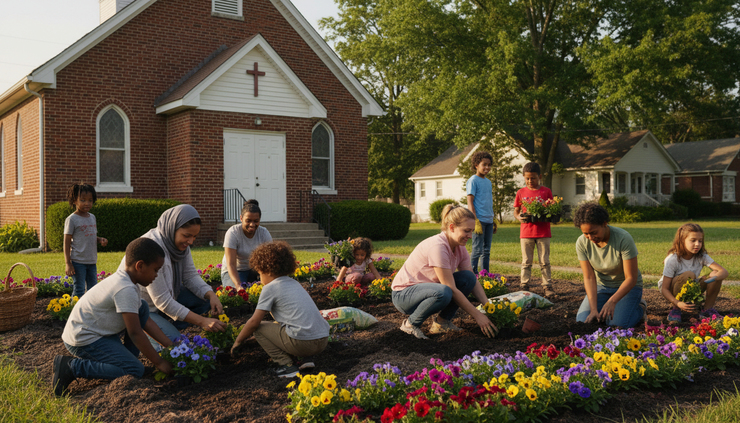
Parents need encouragement too
Parents carry a kind of responsibility that is hard to explain until living it. They make decisions every day that affect the people they love most. They often wonder if they are doing enough, saying the right things, setting the right limits, or missing something important.
Church connection gives parents a place to be encouraged, not just needed.
In a healthy church community, parents can find people who understand the weight of family life. They may meet older parents who have already walked through toddler years, teenage years, college transitions, blended family dynamics, or caregiving seasons. They may find peers who are dealing with the same questions in real time.
Those relationships can become a real source of wisdom.
A parent may receive help through:
A conversation after service
A small group discussion
A parenting class
Prayer with another parent
A meal during a difficult week
Childcare support during a church gathering
Advice from someone with life experience
The value is not always in formal programming. Sometimes the greatest gift is hearing, “We went through that too, and you are not alone.”
Parents also need spiritual care. A church can remind them that their worth is not measured by perfect performance. It can help them return to grace when they feel guilty, patience when they feel overwhelmed, and hope when they cannot see the next step clearly.
Church community can strengthen marriages and family relationships
Family success often depends on the health of relationships inside the home. Marriage, co-parenting, sibling bonds, and extended family connections all need attention. A church can help by creating space for reflection, accountability, and support.
Couples may benefit from marriage groups, counseling referrals, mentoring relationships, or simply time with other couples who value commitment and communication. Families may also find help learning how to handle conflict in healthier ways.
Churches often teach practices that support strong relationships:
Listening before reacting
Confessing wrongs and seeking forgiveness
Serving instead of keeping score
Speaking with care
Choosing patience
Honoring commitments
These practices are simple to name and hard to live. That is why community matters. A family surrounded by supportive people has more reminders, more examples, and more encouragement to keep growing.
The same is true for single parents, grandparents raising grandchildren, foster families, adoptive families, and households with unique caregiving needs. Church community should not assume every family looks the same. A strong church recognizes many family structures and offers care with humility and respect.
The goal is not a picture-perfect family. The goal is a faithful, supported, growing family that has help along the way.
Shared values give families a stronger foundation
Every family teaches values, whether by intention or by habit. Children learn from what adults praise, what they ignore, how they handle stress, how they treat neighbors, and what they prioritize.
A community church helps families name and practice values together. It gives language to what matters.
Faith, service, generosity, forgiveness, honesty, compassion, gratitude, and hope become more than abstract ideals. They become part of a weekly rhythm. Families hear them in Scripture, sing them in worship, discuss them in groups, and practice them through service.
This shared foundation can shape decisions at home.
For example, a family that values service may choose to bring meals to someone recovering from surgery. A family that values generosity may involve children in giving to a food pantry. A family that values forgiveness may talk honestly after an argument and make room for repair.
Church does not remove every struggle. It gives families a framework for facing struggles with purpose.

Community church connections provide help during hard seasons
Every family eventually faces a season that is too heavy to carry alone. Illness, job loss, grief, divorce, financial strain, moving, addiction, disability, conflict, or burnout can shake even the strongest household.
A connected church community can become a lifeline in those moments.
Support may look like:
Meals dropped off after a hospital stay
Rides to appointments
Prayer during a crisis
Help with child care
Visits during grief
Financial assistance when appropriate
Pastoral care
Referrals to counselors or local services
People sitting quietly when words are not enough
This kind of care matters because hardship often isolates people. Families may feel embarrassed, exhausted, or unsure how to ask for help. When they are already connected to a church, support can come more naturally. Relationships are already in place before the crisis begins.
That is one reason church connection should not be treated as a last resort. It works best when it is built over time, through ordinary Sundays, shared meals, volunteer hours, small groups, and conversations in the hallway.
A village cannot form overnight. It grows through presence.
Serving together teaches families to look outward
A healthy family does not only receive support. It also learns to give support. Community church involvement gives families meaningful ways to serve together.
That can be powerful for children and adults alike. Serving shifts the family focus from only managing its own needs to noticing the needs of others. It helps children see compassion in action. It reminds adults that they have gifts to offer, even during busy or imperfect seasons.
Families might serve by:
Helping with a church meal
Visiting older members
Packing supplies for local families
Singing in worship
Greeting newcomers
Cleaning up after an event
Supporting a community outreach effort
Writing cards to people who are sick or grieving
Service does not have to be large to be meaningful. A child carrying a bag of groceries, a teen helping set up chairs, or a parent checking on a neighbor can all become part of the family’s spiritual formation.
These moments teach that success is not only personal progress. It includes becoming the kind of people who help others flourish.
Belonging gives families a place to return
One of the quiet gifts of church community is rhythm. Families need rhythms because life changes constantly. Children grow. Jobs change. Friendships shift. Homes move. Seasons of joy and hardship come and go.
A church can become a place to return.
Week after week, families gather with familiar faces. They hear Scripture. They pray. They sing. They remember what matters. They see babies dedicated or baptized, children grow taller, teens mature, couples celebrate anniversaries, and elders share wisdom.
These patterns help families feel rooted.
Belonging also matters for people who feel unseen elsewhere. New families in town, single adults, widows and widowers, military families, immigrants, grandparents, young parents, and people recovering from painful church experiences may all long for a safe place to connect.
A community church cannot be perfect, because people are not perfect. But it can choose to be welcoming, honest, patient, and caring. That kind of church becomes a home base for families trying to build a good life.
Finding the right church connection takes intention
Not every church will be the right fit for every family. That is normal. Families should look for a church community where faith is lived with sincerity and people are treated with dignity.
A strong church connection often includes:
Faithful teaching
The church takes Scripture seriously and teaches in a way that helps people live with wisdom, humility, and love.
Healthy relationships
People are not only friendly on the surface. They show care, accountability, and respect.
Safe children’s and youth ministry
Families should look for clear safety practices, responsible leadership, and age-appropriate teaching.
Room to participate
A good church helps people move from attendance to connection through groups, service, conversation, and shared life.
Care for the whole community
The church looks beyond its own walls and serves neighbors with compassion.
Building connection also requires participation. Families may need to attend consistently, introduce themselves, join a small group, volunteer, ask questions, and make time for relationships. It can feel awkward at first, especially for those who are new or returning after time away.
But connection grows through repeated, simple steps.
Say hello. Stay a few minutes after service. Attend a family event. Join a group. Invite another family for lunch. Ask where help is needed. Share honestly when life is hard.
The village forms one relationship at a time.

The village still matters
The phrase “it takes a village” is more than a sentimental saying. It is a practical truth. Families need community to grow strong, stay grounded, and make it through hard seasons with hope.
A community church can be one of the most meaningful parts of that village. It offers spiritual guidance, trusted relationships, practical support, and shared purpose. It helps children grow with caring adults around them. It reminds parents they are not alone. It gives families a place to serve, heal, learn, and belong.
Family success is not built only inside the walls of a home. It is shaped by the people who surround that home with love, wisdom, and steady presence.
The next step can be simple: visit, reconnect, join a group, ask for prayer, or invite another family into conversation. A strong village begins with one open door and one faithful connection at a time.


Comments